

CFCRA Corn Project: Activity 1 – Development of short season, cold tolerant, disease resistant corn inbreds
Principal Investigator: Lana Reid and Aida Kebede
Research Institution: Agriculture and Agri-Food Canada
Objectives:
- Development and release of early maturing cold tolerant corn inbreds with emphasis on the 1800-2000 CHU market.
- Development of corn inbreds with improved disease resistance to Gibberella ear rot (GER), northern corn leaf blight (NCLB), Goss’s wilt, common rust, and eyespot.
Impacts:
- Release of improved genetics and technology for growing corn in early maturity regions of less than 2800 crop heat units (CHU) will help improve the competitiveness of the crop in those regions.
- The release of improved corn inbreds with disease resistance provides genetics to the seed sector to help reduce the incidence and severity of the major diseases on corn hybrids, especially those diseases contaminating the grain with mycotoxins.
- Information to help corn growers to select appropriate resistant hybrids.
Project Overview:
This activity used conventional corn breeding methodology enhanced by double haploid inbred production and specialized screening techniques for cold tolerance and disease resistance to develop early maturing cold tolerant corn inbreds with improved disease resistance to Gibberella ear rot (GER), northern corn leaf blight (NCLB), Goss’s wilt, common rust, and eyespot. Multiple yield trials in Alberta, Manitoba, Quebec, Ontario, and PEI were conducted annually. Disease nurseries for GER, NCLB, rust and eyespot were conducted in Ottawa, and one new nursery was established in Manitoba for Goss’s wilt. Annual surveys for current and emerging diseases were conducted to continue to guide the inbred development program on which diseases to put more resources into and to scout for new/emerging diseases.
Results:
The five-year project successfully released 21 new inbred lines (Table below). Of these, seven lines were specifically validated for the 2200–2500 CHU maturity zones, providing reliable adaptation for short-season environments. Six lines demonstrated strong resistance to Gibberella ear rot (GER) under high inoculum pressure, while three lines consistently expressed stable resistance to Northern Corn Leaf Blight (NCLB). Resistance to common rust was confirmed in seven lines, and five lines incorporated effective resistance to eyespot. In addition, four lines carry a “sugarcorn” genetic background, supporting the development of specialty hybrids.
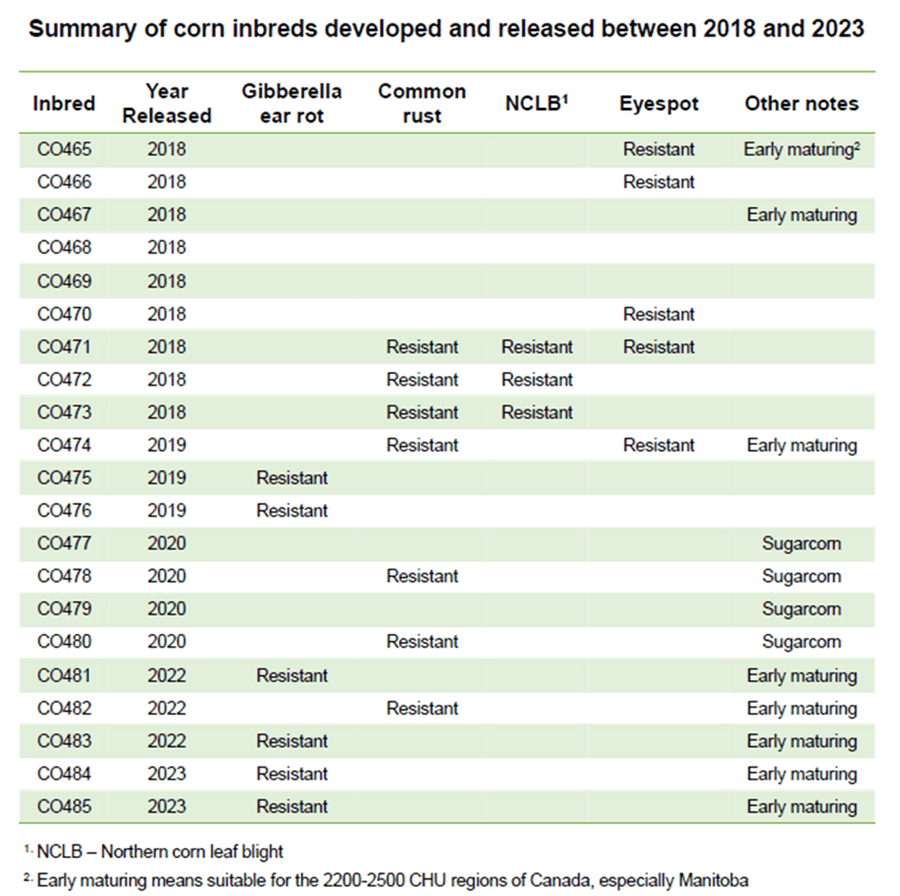
These 21 lines exhibit hybrid performance equivalent to—and in some cases exceeding—that of widely used check hybrids. Their deployment is expected to reduce the need for fungicide applications, lowering production costs and supporting more sustainable disease management. Importantly, their release expands the range of adapted, reliable seed options for Manitoba and the shorter-season grain and silage production regions of Northern Ontario and Québec.
Details of results for each project objective are summarized below.
Objective 1: Development of corn inbreds with early maturity and cold tolerance
The development of early-maturing and cold-tolerant inbred lines began with biparental crosses between elite germplasm and Canadian-adapted corn inbred lines. Each generation was selectively advanced based on key criteria: early maturity, adaptation to Canadian growing conditions, and desirable agronomic characteristics, both in the inbred state and when testcrossed to inbred testers to evaluate hybrid performance.
The initial goal was to develop corn inbred lines suitable for the 1800–2000 CHU maturity range. Through successive selection and advancement, the earliest released inbred, CO485, achieved 2200 CHU, followed by CO484, which reached 2500 CHU. These two extra-early maturing inbreds (CO484 and CO485) have been released to the seed corn industry and made available to researchers, supporting both commercial hybrid development and academic research programs.
The cold tolerance screening experiments were conducted to develop a practical and reliable screening pipeline for cold tolerance during germination and early seedling growth in corn, enabling earlier planting and improved stand establishment under Canadian spring conditions. The study evaluated multiple biparental crosses derived from elite and adapted inbred lines. Seeds from each cross were tested for emergence and seedling vigor at low temperatures representative of early spring soils. Seeds from each cross were germinated under controlled low temperatures (9°C constant and 13/7°C day/night) to simulate early spring conditions. Digital image analysis was applied to all seedlings to measure coleoptile length, root length, and root number, while days to emergence (DTE) was recorded for emerged plants. Results showed that coleoptile length strongly predicted emergence ability under chilling, outperforming DTE alone; lines with longer coleoptiles tended to emerge faster and more reliably. Crosses varied widely with certain combinations (e.g., involving CO462 and CM145) producing families with stronger coleoptiles and stronger root systems. Image-based phenotyping provided objective and scalable trait measurement even when emergence was incomplete. In conclusion, coleoptile length is a robust, cost-efficient screening trait for cold tolerance. The pipeline can help breeders select parents and progeny with improved early vigor, supporting earlier planting in cool climates. Controlled environment screening accelerates the breeding cycle and complements field testing. Future work should integrate survival analysis for emergence data, estimate variance components and heritability, and confirm trait predictiveness under multi-environment field trials.
Objective 2: Development of corn inbreds with improved disease resistance
Nurseries in Ottawa, ON and Ridgetown, ON were established each year for identifying lines showing resistance to Gibberella ear rot (GER) and northern corn leaf blight (NCLB). Promising lines for the different diseases were selected and advanced.
More than 100 accessions were tested for eyespot and rust resistance in Ottawa.
New sources of resistance were identified for NCLB, common rust, and eye spot, and crosses were made to develop populations for screening and selection.
Goss’s bacterial wilt and leaf blight, once largely confined to the U.S. Great Plains, has now expanded its range into Canada. Harding et al. (2018) confirmed its establishment in Manitoba and Alberta, with increasing reports emerging from the eastern Prairies. In response, a dedicated Goss’s wilt screening nursery was established at Carberry, Manitoba, providing a controlled, high-pressure environment for selecting and advancing resistant germplasm. This initiative has already identified several promising resistant lines, with the first Goss’s wilt–resistant inbred line targeted for release in 2025. The Carberry nursery has become a critical national resource, enabling public and private breeding programs to rigorously evaluate and deploy resistance to Clavibacter nebraskensis proactively, thereby reducing production risk as corn acreage expands westward.
From 2018-2023, Ontario corn disease surveys documented a shift in foliar and ear diseases (Jindal et al., 2019; Zhu et al., 2020; 2022; 2023). NCLB remained the most important foliar disease, with severity generally low to moderate but spiking in warmer, wetter seasons such as 2019 and 2022. Race monitoring work during this period, including Jindal et al. (2019), showed that Ontario populations of Exserohilum turcicum are highly diverse, comprising at least 17 physiological races, and that over 75% of isolates can overcome more than one Ht resistance gene, with some races virulent to all tested Ht genes. This diversity explains variable field performance of hybrids and underscores the need to stack and rotate effective NCLB resistance sources.
Breeding research responded to these challenges. Zhu et al. 2023 showed that polygenic (PG) resistance alone or combined with Ht genes provided the greatest reduction in NCLB disease rating, lesion size, and lesion number compared to single dominant Ht genes. Specific combinations such as Htm1/Ht2 or PG/Htm1 showed strong and stable effects, while additive gene action dominated overall but with some over-dominance for key traits. These findings support Ontario’s shift toward pyramiding multiple quantitative resistance sources with selected Ht genes to slow race adaptation.
Common rust remained nearly ubiquitous each year, while southern rust steadily advanced northward, becoming an annual but usually moderate threat by 2022. Grey leaf spot (GLS) gained importance in southwestern Ontario and began appearing farther east, while eyespot persisted at moderate but variable levels.
Ear and stalk rots, especially GER and associated DON contamination, were highly weather dependent. Most seasons saw low to moderate DON, but 2022 and 2023 included local hotspots where late harvest and moist conditions prevailed. A major new development was the first confirmed tar spot detections in 2021-2022 in Essex and Chatham-Kent, mirroring U.S. Midwest trends and signaling a potential future epidemic threat.
Collectively, these surveys and the Jindal et al. 2019 race analysis show that Ontario’s disease pressure is intensifying and shifting. Breeding programs must prioritize multi-gene, race-specific and non-race-specific NCLB resistance, improved tolerance to GLS, rusts, and GER/DON, and early incorporation of tar spot resistance from currently available sources such as tropical germplasm from CIMMYT. Coupled with integrated management (fungicide stewardship, residue and harvest timing practices) and climate-driven disease forecasting, these efforts will be critical to sustain grain quality and yield stability under increasingly variable Ontario growing conditions.
External Funding Partners:
This activity was funded in part by the Government of Canada under the Canadian Agricultural Partnership’s AgriScience program with industry support from the Canadian Field Crop Research Alliance (CFCRA) whose members include: Atlantic Grains Council; Producteurs de grains du Quebec; Grain Farmers of Ontario; Manitoba Corn Growers Association; Manitoba Pulse & Soybean Growers; Saskatchewan Pulse Growers; Prairie Oat Growers Association; SeCan; and FP Genetics.
Project Related Publications:
Kebede, A. Z., Voloaca, C., Wu, J., Bowman, B., Wang, Z., Woldemariam, T., and Zhu, X. 2024. CO481 corn inbred line. Canadian Journal of Plant Science. 104(1): 82-87.
Shumilak, A., El-Shetehy, M., Soliman, A., Tambong, J. T., and Daayf, F. 2023. Goss’s wilt resistance in corn is mediated via salicylic acid and programmed cell death but not jasmonic acid pathways. Plants 12.
Zhu, X., Reid, L.M., Woldemariam, T., Wu, J., Jindal, K.K., Kebede, A.Z. 2023. Resistance breeding for northern corn leaf blight with dominant genes, polygene, and their combinations—effects on disease traits. Agronomy. 13: 1096.
Zhu, X., Kebede, A.Z., Woldemariam, T. 2023. Status of corn disease in Eastern Ontario, 2022 crop season. Pp77-81. In: Elmhirst, J. (2023). Canadian Plant Disease Survey 2023 Volume 103: Disease Highlights 2022. Canadian Journal of Plant Pathology, 45(sup1), 1–171.
Blackwell, B., Schneiderman, D., Thapa, I., Bosnich, W., Pimentel, K., Kebede, A.Z., Reid, L.M., and Harris, J.L. 2022. Assessment of deoxynivalenol and deoxynivalenol derivatives in Fusarium graminearum-inoculated Canadian maize inbreds. Canadian Journal of Plant Pathology. 44(4): 504-517.
Kebede, A. Z., Reid, L. M., Voloaca, C., De Schiffart, R., Wu, J., Woldemariam, T., Jindal, K. K., Zhu, X., and Morrison, M. J. 2022. CO477, CO478, CO479, and CO480 inbred lines. Canadian Journal of Plant Science. 102(2): 488–495.
Telenko, D.E.P., Chilvers, M.I., Ames, K., Byrne, A.M., Check, J.C., Da Silva, C.R., Ross, T.J., Smith, D.L., and Tenuta, A. 2022. Fungicide efficacy during a severe epidemic of tar spot on corn in the United States and Canada. Plant Health Progress. 23(3): 342-344.
Zhu, X., Kebede, A.Z., Woldemariam, T. 2022. Status of corn disease in Eastern Ontario, 2021 crop season. Pp97-99. In: Elmhirst J. (2022) Canadian plant disease survey 2022 volume 102: disease highlights 2021. Canadian Journal of Plant Pathology, 44(sup1), 1-187.
Kebede, A. Z., Reid, L. M., Voloaca, C., De Schiffart, R., Wu, J., Woldemariam, T., Jindal, K. K., Zhu, X., Bosnich, W., Johnston, A., Schneiderman, D., and Harris, L. J. 2021. CO476 corn inbred line. Canadian Journal of Plant Science. 101(2): 287–291.
Kebede, A. Z., Reid, L. M., Voloaca, C., De Schiffart, R., Wu, J., Woldemariam, T., Jindal, K. K., and Zhu, Z. 2021. CO475 corn inbred line. Canadian Journal of Plant Science. 101(2): 292–297.
Zhu, X., Reid, L. M., Kebede, A. Z., Tenuta, A. U., and Woldemariam, T. 2020. Status of corn diseases in Ontario, 2019 crop season. Canadian Plant Disease Survey. 100: 108-112.
Jindal, K. K., Reid, L. M., Tenuta, A. U., Woldemariam, T., and Zhu, X. 2019. Status of corn diseases in Ontario, 2018 crop season. Canadian Plant Disease Survey. 99: 117-121.
Jindal, K. K., Tenuta, A. U., Woldemariam, T., Zhu, X., Hooker, D. C., and Reid, L. M. 2019. Occurrence and distribution of physiological races of Exserohilum turcicum in Ontario, Canada. Plant Disease. 103(7): 1450-1457.
Reid, L. M., Zhu, X., Jindal, K. K., Woldemariam, T., Wu, J., and Voloaca, C. 2019. CO468, CO469, CO470, CO471, CO472, and CO473 corn inbred lines with improved northern corn leaf blight resistance. Canadian Journal of Plant Science. 99(6): 972-984.
Reid, L. M., Gowan, R., Voloaca, C., Wu, J., Woldemariam, T., Jindal, K. K., and Zhu, X. 2019. CO467 corn inbred line. Canadian Journal of Plant Science. 99(3): 394-398.
Reid, L. M., Zhu, X., Wu, J., Voloaca, C., Woldemariam, T., and Jindal, K. K. 2019. CO466 corn inbred line. Canadian Journal of Plant Science. 99(3): 407-412.
Reid, L. M., Voloaca, C., Wu, J., Woldemariam, T., Jindal, K. K., and Zhu, X. 2019. CO465 corn inbred line. Canadian Journal of Plant Science. 99(3): 388-393.
Harding, M. W., Jindal, K., Tambong, J. T., Daayf, F., Howard, R. J., Derksen, H., Reid, L. M., Tenuta, A. U., and Feng, J. 2018. Goss’s bacterial wilt and leaf blight of corn in Canada – disease update. Canadian Journal of Plant Pathology, 40(4), 471–480.
Kebede, A. Z., Johnston, A., Schneiderman, D., Bosnich, W., & Harris, L. J. 2018. Transcriptome profiling of two maize inbreds with distinct responses to Gibberella ear rot disease to identify candidate resistance genes. BMC Genomics. 19(1): 131.