

Adaption mechanisms associated with survival under low-temperature flooding and ice encasement in Ontario winter wheat (Triticum aestivum L.)
Principal Investigator: Eric Lyons
Research Institution: University of Guelph
Objectives:
- To determine the impact of low-temperature flooding and ice encasement (LTFIE) events on the survival and maintenance of cold hardiness in historical and modern Ontario winter wheat varieties of interest using data from existing winter wheat programs (e.g., Branson, 25R46, CM614, Priesley, Secord, and winter rye and winter barley checks: AC Hazlet and LCS Calypso, respectively).
- To determine the causal factors associated with plant injury and death under LTFIE in Ontario winter wheat.
- To correlate morphological and physiological traits: survival under ice encasement (LD50 – days required to kill 50% of plants); low-temperature tolerance (LT50 – temperature required to kill 50% of plants), and biochemical properties (e.g., total non-structural carbohydrates, fructans, reactive oxygen species) associated with superior survival under LTFIE for screening in a breeding program.
- Determine the usefulness of chamber, field, and hybrid screening systems for selecting genotypes with superior winter survival under ice encasement in field conditions.
- Evaluate varieties for traits associated with LTFIE survival to inform breeding programs.
- To determine the impact of seeding date, growth stage, and fertility (e.g., phosphorous) on the morphological, physiological, and biochemical components of winter survival under LTFIE.
- To develop a statistical model to predict winterkill events using historical environment data and new data from ground-level sensors across Ontario. The model will allow for an economic impact of past and potentially future winterkill events when using winter wheat in Ontario farming systems specific to the wheat-growing regions across Ontario. The model will predict risk economic cost associated with late planting or reduced plant size because of fertility limitations to aid in better management decisions on the farm.
Impacts:
- Understanding the physiological and biochemical mechanisms that confer greater survival under LTFIE has given breeders the opportunity to screen populations for traits associated with superior survival in the absence of severe winter conditions. This new information will result in the development of elite winter wheat varieties that are better adapted to Ontario’s climate, while preserving yield. Having superior varieties will allow more farms to adopt winter wheat in rotation, resulting in better on-farm sustainability.
- Understanding the relationship between vegetative recovery and yield has given clear insight into the timing of winter survival note-taking and its impacts on the development of resilient, winter-hardy varieties.
- A new Ontario area map based on components of winterkill is in progress based on the model and is beneficial for data-based recommendations for producers. The Ontario area map is designed to allow breeders to target components of winterkill (e.g., snow mould, frost heaving, ice encasement, etc.) for specific growing regions, therefore reducing risks associated with winterkill and creating more profitable farm systems.
- The development of an Eastern Canada Winter Cereal Survival Model is in continual progress and is designed allow farmers to monitor cumulative winterkill days, manage risk, and make informed management decisions earlier in the year concerning the economic value of fall fertility to increase plant size and potential survival of winter wheat.
- The economic impact of winterkill is difficult to determine due to confidentiality of data. This research allowed for the prediction of the economic impact of winterkill in winter wheat across the different regions of Ontario.
Scientific Summary:
The adaptive strategies of Ontario winter wheat cultivars to LTFIE events have not been specifically addressed by researchers in favour of selection for broad ‘winter survival’. Previous studies have suggested that exposure to LTFIE conditions significantly reduces winter survival of winter wheat through direct kill or by increasing the risk of winterkill by reducing hardiness before early spring thaw-refreeze events. Variation for survival under ice encasement has been noted in other winter wheat-growing regions ranging from 2 to 13 days depending on screening method and field versus chamber acclimation procedures. Variation for such traits in modern Ontario winter wheat was unknown. The cause of plant injury and death under these anaerobic conditions was also not well understood, limiting selection for improved varieties based on morphological and physiological traits. Historical lines may possess superior adaptive strategies lost due to selective breeding in the absence of severe winter environmental stresses.
Initial studies evaluated historical and modern Ontario winter wheat varieties for variation in survival under LTFIE. Field- and chamber-acclimated plants were evaluated for survival under ice encasement, and LD50 (days required to kill 50% of plants), LT50 (temperature required to kill 50% of plants), and biochemical traits associated with cold hardiness (including total non-structural carbohydrates, fructans, and sucrose) were measured. The effect of planting date, growth stage and fertility (e.g., phosphorous application) on these components of cold hardiness were also evaluated on field and chamber-acclimated plants.
Results:
Growth Chamber (Objective 1 Deliverable)
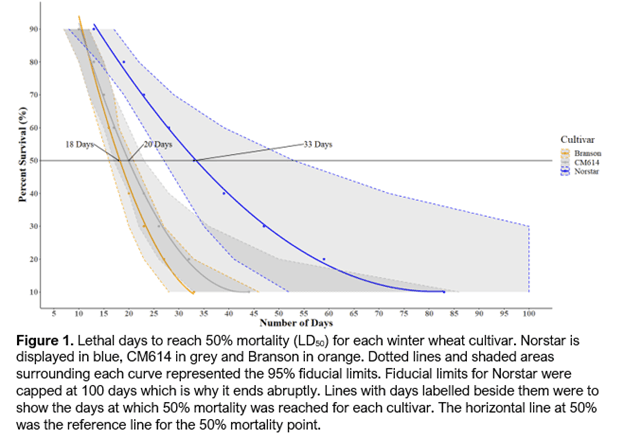
LD50 (days required to kill 50% of plants)
Among the cultivars, Norstar had the longest LD50 (33 days) while Branson (18 days) and CM614 (20 days) were similar (Figure 1). Differences were based on the 95% confidence limits around the LD50 for each cultivar. The observed differences in LD50 among winter wheat cultivars help characterize the survival of wheat under LTFIE, as it shows how different cultivars can tolerate longer periods under freezing temperatures and ice encasement.
LT50 (temperature required to kill 50% of plants)
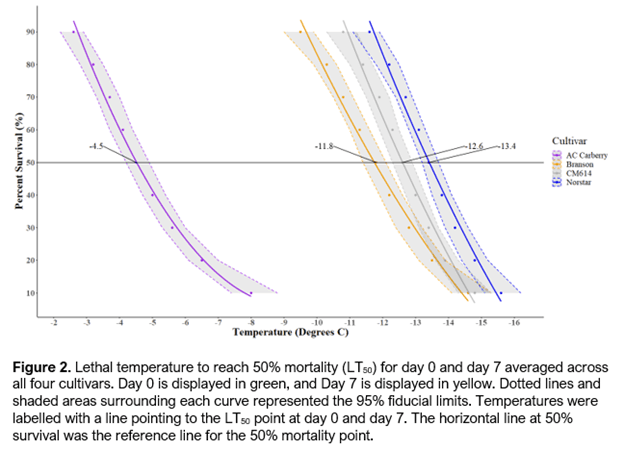
Day 0 (zero days under ice) had a lower LT50 (-10.9oC) than day 7 (seven days under ice) (-9.2oC) when averaged across all four cultivars based on the 95% confidence limits. Norstar had the lowest LT50 when averaged across days (-13.4oC), followed by CM614 (-12.6oC), Branson (-11.8oC), and AC Carberry (-4.5oC) (Figure 2). All four cultivars had different LT50’s from each other based on the 95% confidence limits.
Biochemistry
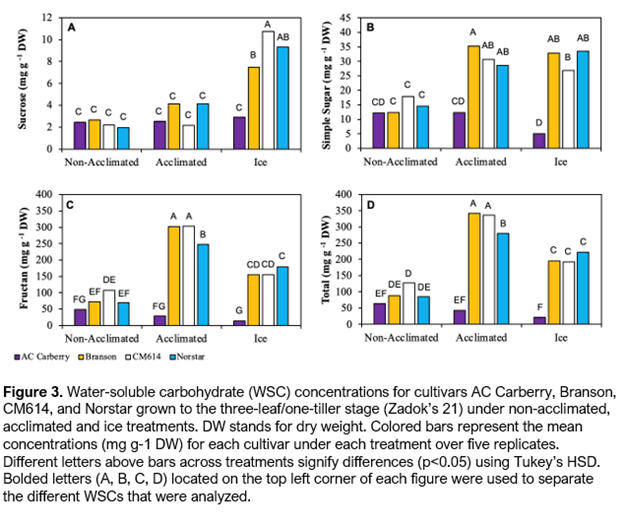
The winter wheat cultivars (Branson, CM614, and Norstar) had the highest water-soluble carbohydrate (WSC) concentrations under acclimation and ice, while the spring wheat cultivar (AC Carberry) had the lowest WSC concentrations under acclimation and ice (Figure 3). For simple sugars, when plants were not acclimated, the levels were similar between cultivars but as plants were acclimated and under ice, the levels within Branson, CM614, and Norstar increased whereas AC Carberry decreased. Similar trends were observed for sucrose and fructans (Figure 3).
Field (Objective 2 Deliverable)
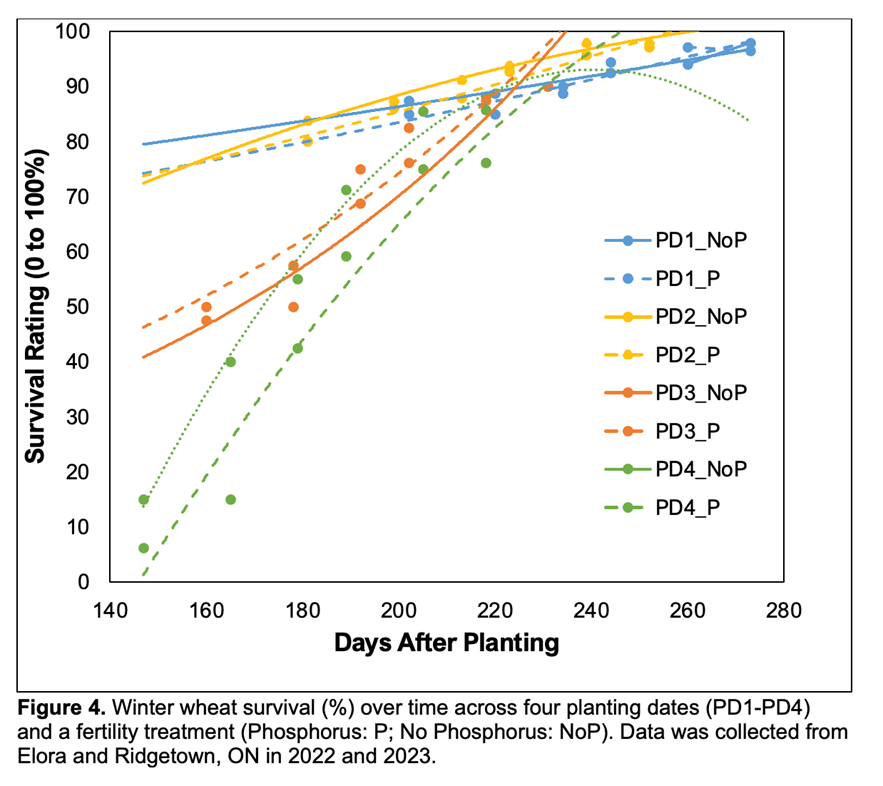
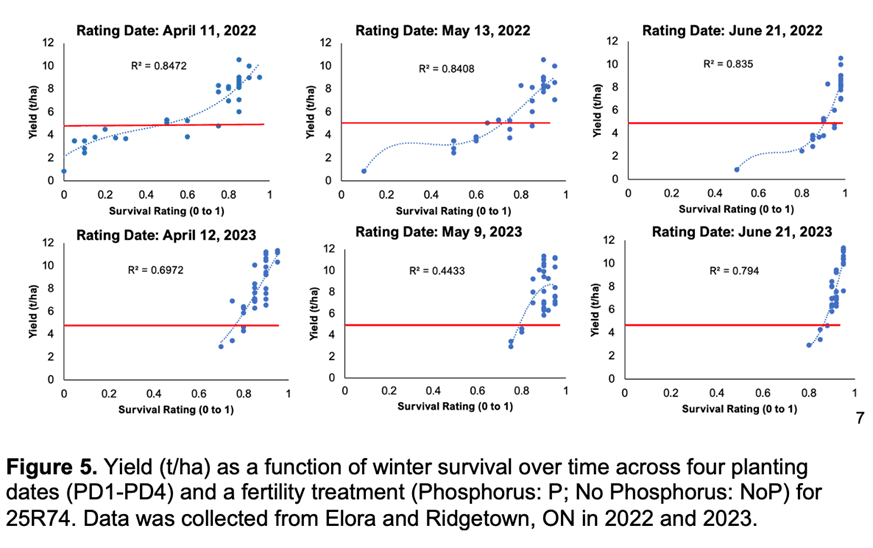
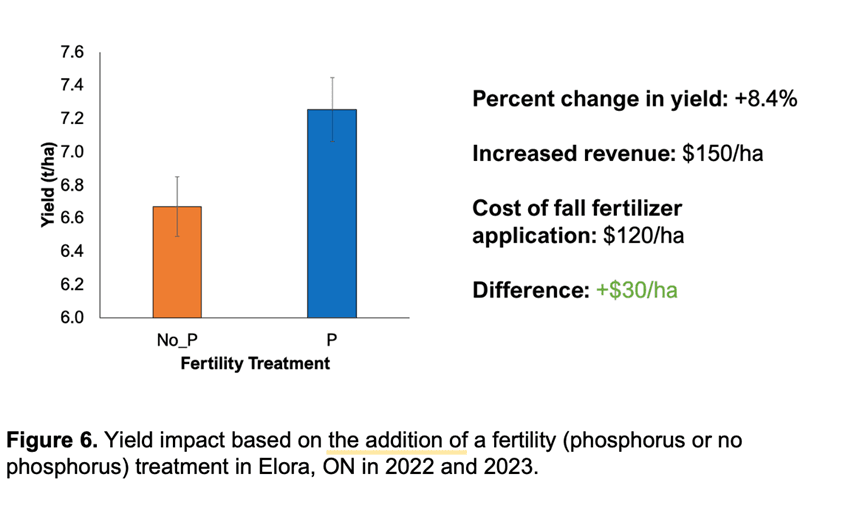
Planting dates 1 and 2 showed the most consistent yields, with planting date 2 (Oct. 13, 2021, and Oct. 6, 2022) being optimal. Winter survival ratings revealed that wheat genotypes can recover vegetatively; however, yields did not reflect this recovery across all genotypes (Figures 4 and 5). The addition of phosphorus treatments revealed differences for the check varieties (AC Hazlet and LCS Calypso) and combined data revealed significant increases in winter wheat yields (Figure 6).
Modeling (Objective 3 Deliverable)
This deliverable is in the process of validation. Historical environmental data and historical Ontario Cereal Crop Committee (OCCC) data will be used for validation. Initial models show moderate success in their ability to predict winterkill events across regions of Ontario.
External Funding Partners:
This project was funded in part by the Ontario Agri-Food Innovation Alliance, a collaboration between the Government of Ontario and the University of Guelph.
Project Related Publications:
Husiny J., Ficht A., Whiting R., Booker H., Hooker, D., McElroy M., and Lyons E. 2025. Carbohydrate content of winter wheat (Triticum aestivum L.) under low-temperature flooding and ice encasement. Under Review.
Husiny J., Ficht A., Whiting R., Booker H., Hooker, D., McElroy M., and Lyons E. 2024. Improved methods to estimate days and temperature to fifty percent mortality of winter wheat (Triticum aestivum L.) under low-temperature flooding and ice encasement. Canadian Journal of Plant Science. 104(3).