
Canadian National Wheat Cluster: Activity 3 – Development of spring wheat varieties to enhance profitability for producers in Quebec and Eastern Canada
Principal Investigator: Silvia Barcellos Rosa
Research Institution: Centre de recherche sur les grains (CÉROM)
Objectives:
- Delivery of new spring wheat cultivars (Canadian Eastern Red Spring, CERS) with high grain yield, superior disease resistance (including FHB and wheat rusts), and adequate end-use quality to allow eastern producers to deliver their production to millers.
- Develop wheat with ultra-high yield suitable for livestock feed.
Impacts:
- The spring wheat breeding program of CÉROM has been restructured since 2017, making it more efficient to deliver better cultivars to Eastern Canadian farmers in a faster time frame.
- The program is successfully delivering new spring wheat cultivars to eastern Canada. Since the start of the 2018-2023 cluster, two (2) cultivars were registered and marketed (AAC Maurice – CERS and AAC Volta – feed wheat), and three (3) lines were supported for registration as feed wheat in Quebec, CRGB-19.03, CRGB-20.01 and CRGB-21.01. The last ones are being offered to seed companies for commercialization.
- Selection of genotypes with excellent Fusarium head blight (FHB) resistance.
- In the pipeline, the program has chosen lines with improved quality, resistance to diseases, and yield adaptability, which will increase farmer profitability, providing a positive impact on the wheat chain in Eastern Canada.
Project Overview:
The spring wheat area in eastern Canada had increased over the last decades. In Québec, the average seeded area increased 65% in the period 2014-2018 compared with the period 2009-2013. Production also increased by 81% during the same period. The 2020 and 2021 Quebec seasons were impacted by drought conditions, which likely influenced farmers to seed less spring wheat in the region in 2021 and 2022. The average grain yield has increased from 2020 (2.31 t/ha), when the crop substantially suffered with dry and hot conditions, to 2022 (3.79 t/ha). Wheat (spring and winter) increased by 39% in total production in 2021-2022 compared with the 2020-2021 season. Wheat prices increased due to the drought in Western Canada and the United States. As a result, the price premium between feed wheat and wheat for human consumption (at around C$50/t) was attractive to producers, unlike in previous years when the price difference was between $10 and $20/t.
Quebec millers are interested in increasing their use of local wheat. Quebec needs to import wheat to support its domestic market. However, they need better milling quality and a higher acreage of wheat in the province. To increase the competitiveness of wheat in eastern Canada, it is necessary to improve the profitability of the crop, which will be possible with better productivity, resistance to major diseases, principally Fusarium head blight (FHB), and improved milling characteristics. In 2020, the Quebec wheat registration committee changed the milling quality parameter thresholds to improve the quality and the segregation of Quebec wheat. Improvement should be seen within a few years.
CÉROM’s spring wheat breeding program aims to develop field-ready spring wheat cultivars adapted to eastern Canadian production areas that will contribute to increasing producers’ net returns, meet grain quality for end-users, and assist with environmental sustainability. The first objective of the project was the delivery of new spring wheat cultivars with high grain yield, superior disease resistance, including FHB and wheat rusts, and adequate end-use quality to allow eastern producers to deliver their production to local millers. The second objective was to develop wheat with ultra-high yield suitable for livestock feed. The project dedicated 70% of the investment, resources, and time to develop improved milling wheat, while the remaining 30% was focused on feed wheat.
Results:
- New Populations: At least one crossing block per year were organized with material derived from eastern and western Canada, Mexico, and South America, aiming to improve quality, disease resistance, and increase genetic diversity. More than 112 new genetic combinations were achieved by single or top-cross crosses, with population sizes ranging from 1,000-6,000 F2 plants.
- Segregating populations derived from the current project or developed during the previous cluster were selected in the field at Saint-Mathieu-de-Beloeil based on agronomic traits (among them, plant type, height, spike fertility and size and disease resistance). After F2 spikes were selected in the field, promising populations were advanced in the greenhouse during winter. They were selected based on molecular markers, which were chosen depending on the parents’ genotypes. Molecular markers were related to disease resistance, plant type, and end-use quality.
- The first yield trials (generally F6 generation) were conducted at Saint-Mathieu-de-Beloeil as a Modified-Augmented-Design without repetition, due to limited seeds. The other yield trials were distributed in one to five locations in eastern Canada (Quebec: Saint-Mathieu-de-Beloeil, Princeville, Normandin; Ontario: Ottawa or Casselman; PEI: Harrington). The lines in yield trials were also tested for FHB resistance and DON level in at least one disease nursery per year. Quality tests were performed at CÉROM’s quality laboratory to discriminate the lines: grain and flour protein, flour yield, test weight, falling number, and glutopeak. Selected lines were tested in the AAFC-Ottawa quality lab.
- The most promising lines were submitted to the provincial registration trials (Quebec – RGCQ, 3 years of trials). At least two lines entered the RGCQ Tamisage trials per year.
In the 2022 field season, the last year of this cluster project, two lines were in the last year of Quebec registration trials (third year trials), CRGB-20.01 and CRGB-20.02. The last had grain yield (101.5%) comparable to the CERS checks AAC Harlaka and Touran, and good resistance to powdery mildew, stripe rust, and barley yellow mosaic virus. The line had symptoms of FHB and DON levels similar to or better than the MS checks (Table 1), but it did not pass the Quebec FHB threshold to be supported for registration.
Table 1. Fusarium head blight (FHB) data of Quebec registration trials nurseries in 2022.
DON (ppm) | FHB index (%) | |||
Cultivar/line | St-Mt-Beloeil | Quebec | St-Mt-Beloeil | Quebec |
AAC Scotia (MR) | 1.7 | 7.9 | 59.7 | 11.5 |
FL62R1 (MR) | 1.2 | 6.8 | 28.5 | 13.0 |
Major (MR) | 1.2 | 8.4 | 38.7 | 12.9 |
Carberry (MS) | 14.4 | 35.0 | 52.0 | 34.3 |
Megantic (MS) | 20.1 | 29.3 | 69.8 | 21.3 |
Sable (MS) | 32.8 | 39.3 | 73.3 | 28.1 |
CRGB-20.01 | 6.6 | 7.8 | 30.5 | 14.4 |
CRGB-20.02 | 8.1 | 19.6 | 64.7 | 19.3 |
CRGB-21.01 | 3.9 | 11.8 | 31.0 | 14.9 |
CRGB-21.02 | 2.2 | 4.9 | 4.3 | 14.9 |
CRGB-21.03 | 6.4 | 10.5 | 40.7 | 19.4 |
The line CRGB-20.01, unfortunately, was not approved by the quality committee to be registered as CERS. The grain yield mean of CRGB-20.01 in areas 1, 2 and 3 during 2020, 2021 and 2022 was 9.4% higher than the mean of the CERS checks (Touran and AAC Harlaka). The line was supported for registration as feed. The agronomical performance of CRGB-20.01 is described in Table 2. This line had good resistance to FHB, leaf rust, stripe rust, and powdery mildew. CRGB-20.01 was offered to seed companies for commercialization.
Table 2. Performance of CRGB-20.01 line in the Quebec pre-registration trial (Tamisage 2020) and in the two years of registration trials (Enregistrement 2021, 2022). Results are the mean of Quebec agronomical areas 1, 2 and 3. The line was compared with the mean of feed checks Bangor and Nass.
| RGCQ – QC – Mean (Areas 1, 2, 3) | ||||
Trial | Enregistrement | Enregistrement | Tamisage | ||
Year | 2022 | 2021 | 2020 | ||
Grain yield (% feed checks) | 113.2 | 88 | 78.8 | ||
Test weight (% feed checks) | 104 | 103.6 | 101.8 | ||
Thousand kernel weight (% feed checks) | 99.5 | 96.9 | 94.5 | ||
Plant height (± cm feed checks) | -8 | -8 | -10 | ||
Lodging (0-9) | 0.3 | 1.1 | 1.3 | ||
Maturity (± days checks) | -1 | 0 | -1 | ||
|
|
| |||
In 2022, three lines were moved from Tamisage to the first year of RGCQ trials: CRGB-21.01, CRGB-21.02 and CRGB-21.03 (Table 3). Their performances are described in Table 3. According to the quality results of 2022, the quality committee objected CRGB-21.01 to being tested as CERS in the second year RGCQ trials but approved the other two lines. The three lines had very good resistance to FHB (Table 1, Figure 1), with CRGB-21.02 showing exceptionally low levels of DON and symptoms. Some seed companies demonstrated interest in CRGB-21.02 and CRGB-21.03.
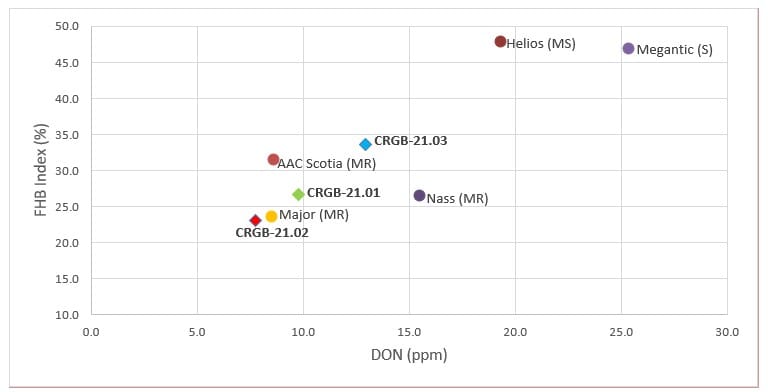
Fig 2. Chart representing the Fusarium head blight (FHB) reaction of the lines in the 1st year of RGCQ trials in 2022: CRGB-21.01, CRGB-21.02 and CRGB-21.03 (in bold). The results are the mean of Tamisage 2021 and Enregistrement 2022 trials at FHB nurseries. Checks are included with their FHB reaction classification.
CRGB-21.01 (feed) had a grain yield similar to the feed check Nass, and its yield was stable over the years and regions. It showed better water absorption (66.2 %) than the quality checks (mean of 62.4%) but failed on falling number (260s). It had good resistance to leaf rust and powdery mildew, but probably not to stripe rust (one-year data).
CRGB-21.02 performed very well in all Quebec regions in 2021 and 2022. It had good resistance to leaf rust, powdery mildew but moderate resistance to stripe rust. The CRGB-21.02 protein was on the lower side, as was the loaf volume, both flagged by the quality committee. No quality trait was considered poor. CRGB-21.02 had very good flour yield and low flour ash. Another year would confirm its end-use quality.
CRGB-21.03 was the only line in which the grain yield was lower than the checks. It performed better in comparison to the checks in the dry year (2021) than in 2022. The line was promising because of its quality; it had the highest protein (15.2%) among the tested lines and quality checks, Touran and Hélios (14.2%). CRGB-21.03 was shorter than the checks and had early maturity. It had good resistance to leaf rust, stripe rust but showed moderate susceptibility to powdery mildew.
Table 3. Performance of CRGB-21.01, CRGB-21.02 and CRGB-21.03 in the Quebec RGCQ trials (mean of 2021 tamisage and 2022 registration trials). Results are the mean of Quebec areas 1, 2 and 3.
| Grain yield | Test weight | Thousand kernel weight | Plant height | Lodging | Maturity | ||
(kg/ha) | (%) | (kg/hl) | (g) | (cm) | (0-9) | (days) | ||
Bangor | 5,017 | 114.8 | 77.9 | 40.2 | 97 | 1.9 | 95 | |
Nass | 4,625 | 105.8 | 78.4 | 36.8 | 99 | 1.9 | 94 | |
AAC Harlaka | 4,411 | 100.9 | 80.6 | 37.5 | 88 | 0.9 | 92 | |
Touran | 4,329 | 99.1 | 80.1 | 42.8 | 90 | 1.2 | 93 | |
CRGB-21.01 | 4,661 | 106.7 | 81.5 | 36 | 90 | 1 | 92 | |
CRGB-21.02 | 5,049 | 115.5 | 80.1 | 40.1 | 87 | 1.6 | 92 | |
CRGB-21.03 | 4,162 | 95.2 | 79.7 | 33.9 | 84 | 0.8 | 91 | |
Feed checks: Bangor et Nass; CERS checks: AAC Harlaka and Touran. The relative grain yield is the result of the comparison of the grain yield of each line with the mean of CERS checks.
External Funding Partners:
This activity was funded in part by the Government of Canada under the Canadian Agricultural Partnership’s AgriScience Program, with industry support from the Canadian Field Crop Research Alliance (CFCRA) members, including: Atlantic Grains Council; Producteurs de grains du Quebec; Grain Farmers of Ontario; and SeCan.
Project Related Publications:
McCallum, B., Reimer, E., McNabb, W., Foster, A., Rosa, S., and Xue, A. 2021. Physiologic specialization of Puccinia triticina, the causal agent of wheat leaf rust, in Canada in 2015-2019. Canadian Journal of Plant Pathology. 43(2021): S333-S346.
Rosa, S.B., Humphreys, G., Langille, L., Voldeng, H., Henriquez, M.A., Burt, A.J., Randhawa, H.S., Fetch, T., Hiebert, C.W., Blackwell, B., Zegeye, T., Cummiskey, A., Fortier, E., Scheeren, P.L., Turra, C., McCallum, B. 2023. Characterization of Brazilian spring wheat germplasm and its potential for increasing wheat genetic diversity in Canada. Frontiers in Genetics. 14.
Rosa, S.B., Zanella, C.M., Hiebert, C.W., Brûlé-Babel, A.L., Randhawa, H.S., Shorter, S., Boyd, L.A., McCallum, B.D. 2019. Genetic characterization of leaf and stripe rust resistance in the Brazilian wheat cultivar Toropi. Phytopathology. 109(10): 1760-1768.